Businesses rarely stay exactly the same. Services expand, priorities shift, and sometimes a part of the company that was secondary for years becomes a much bigger opportunity.
The website doesn’t always change at the same pace.
At first, updating it can seem straightforward. Add a few pages for the new services, revise the homepage, adjust the navigation and move on. For an established business with years of website history and local search visibility, though, those changes can be more complicated than they appear.
We recently ran into exactly this situation with a service business we’ve worked with for many years.
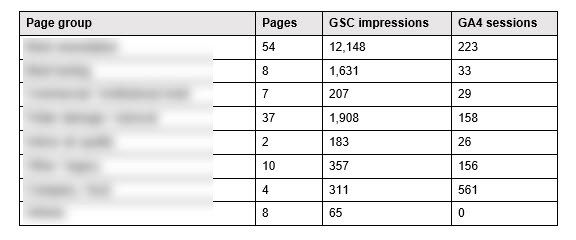
Over 60% of the website content was centered around one service and locations. That made sense historically. The homepage was heavily optimized around it, much of the supporting content reinforced it, and the company had established search visibility around that part of the business.
But the company’s priorities had changed. They wanted to put considerably more emphasis on a second service while also expanding a third.
That raised the real question: How do you make the website reflect where the business is going without hurting what is already successful?
You Can’t Treat an Established Website Like a Blank Slate
If we were building this website from scratch today, its structure would probably look very different. But an established site comes with history. Existing pages may already rank for valuable searches, other websites may link to them, and Google may have years of signals connecting particular pages and topics with the business.
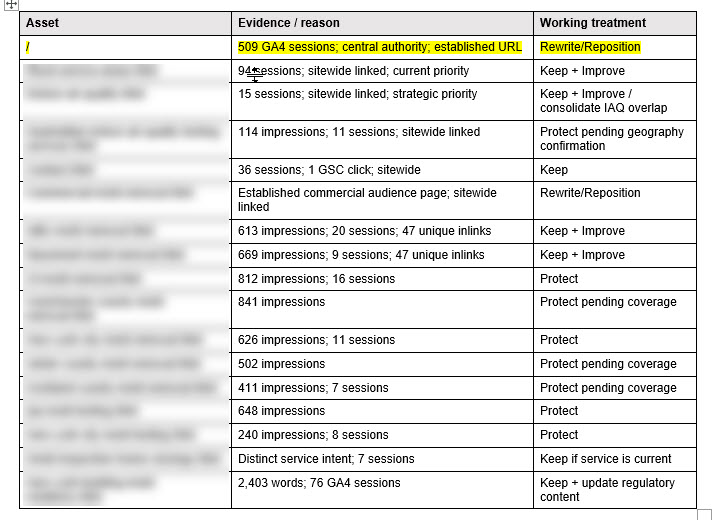
Understanding that history requires more than reading through a few important pages. We needed to go through the entire website and then tie what we found back to actual traffic and visitor data. A page that appears outdated or less important from a marketing standpoint may still be bringing in relevant visitors. Another page that seems prominent within the site may contribute very little.
That meant looking at the website structure alongside page traffic, search queries, landing-page activity and how visitors were actually finding and using the site. Before deciding what should change, we needed answers to questions such as:
- Which existing pages were attracting search traffic, what searches were bringing people there, and was that traffic relevant to the business?
- Were there existing URLs already ranking for searches related to the services the company wanted to expand?
- Which services were overrepresented compared with the company’s current priorities?
- Which newer services had little or no meaningful website support?
- Which older pages still deserved to remain prominent?
- Which pages could be expanded, consolidated or repositioned?
- Were there pages that should simply be left alone?
The goal wasn’t to preserve everything because it was old. It was to avoid throwing away something valuable simply because the business wanted to change direction.
This kind of analysis is part of how we approach SEO and website search visibility: looking at the existing site and its performance before deciding what should be changed.
The Homepage Was One of the Hardest Parts
The homepage presented a particularly interesting problem because it had been built around the company’s original primary service. Its title, headings, copy and internal links all supported that focus.
From a search standpoint, that wasn’t necessarily a problem. In fact, it was part of what had worked.
Simply replacing the homepage copy with the new priority service could mean giving up relevance the page had built around the original service. But leaving it alone would continue to tell customers and search engines that the original service was still the company’s overwhelming focus.
We needed to broaden what the homepage communicated without turning an established, successful page into an entirely different page overnight.
That meant working through questions such as:
- How much of the existing service language should remain?
- Where should the newer priorities appear?
- Could navigation changes give the expanding services more visibility?
- Should the homepage introduce those services while stronger individual pages handle the deeper content?
- Could internal linking be adjusted without disrupting useful existing pages?
None of those decisions is especially dramatic on its own. Together, though, they determine what the website tells customers and search engines about what the company does and which services matter most.
Knowing the Name of a Service Isn’t Enough
Once we began planning content for the expanding services, another problem became obvious. “We offer this service” doesn’t give you much to work with.
To create pages that were genuinely useful, we needed the client to explain how they actually performed the work. That meant getting beyond service names and talking about the details of the operation.
We asked questions such as:
- What equipment do you use?
- What does the process actually involve?
- Are there different methods depending on the situation?
- What can you handle that another provider may not?
- What makes your approach different from competitors?
- Are there common misconceptions customers have about the service?
- What information does a customer usually need before deciding who to hire?
Those details turned out to be much more valuable than generic marketing language. A business owner may consider a particular piece of equipment, process or capability completely routine because they deal with it every day. A prospective customer may have no idea that the distinction exists, and a competitor may not offer the same thing at all.
That’s information we aren’t going to get from a keyword report or by rewriting what competitors already say. We have to get it from the people who actually do the work.
That is often where useful service content and real differentiation come from. It also prevents a new service page from becoming another version of the same page found on ten competing websites: a definition of the service, a few broad benefits and a phone number.
The Website Isn’t the Only Thing That May Be Out of Date
For a local or regional service company, changing the website is only part of the job. Google Business Profile, Bing, Apple Maps and industry directories may all contain information about the business. Those listings may have been created years ago, when the company’s service mix was very different.
The website might now describe three major services while an important local listing still presents the company almost entirely around the original one. So we also needed to check:
- Are the primary business categories still appropriate?
- Are important newer services represented where they should be?
- Does the website support the services being presented in local listings?
- Do service areas still reflect where the company actually works?
- Are older descriptions still giving an incomplete picture of the business?
This doesn’t mean changing every listing at once or adding every possible service everywhere. An established local presence may already be producing useful visibility.
We want the listings to catch up with the business, but not by making wholesale changes to something that is already working.
Adding Another Service Page May Not Fix the Structure
A newer service may already appear throughout the website without having a clear place of its own. There might be a paragraph about it on the homepage, another mention on an older service page, a blog article covering part of the subject and references scattered across location pages.
Then someone adds a new standalone service page. But the problem is that adding another page doesn’t necessarily fix that structure. You can end up with several URLs discussing roughly the same subject without making it clear which page is the main resource or how the supporting information fits together.
If a service has become more important to the business, the site should generally reflect that importance through navigation, internal links, supporting content and the depth of the primary service page.
Sometimes that requires significant restructuring. Other times the solution is much smaller. You might strengthen one existing page, give it better internal links, add the information that was missing and make sure that related consistently link to it.
The right answer depends on what is already there. That’s one reason our website and digital consulting work often begins with figuring out the problem before deciding on the project direction.
Measure twice, cut once, as the tailors say.
Sometimes Realignment Is Better Than a Redesign
Expanding a service line can require much more than adding a page to the website. On an established site, you have to understand what is already working, where the existing structure no longer matches the business, and what information is needed to properly support the services you want to grow.
The important part is making decisions abut what to cut, keep or expand is made from evidence rather than assuming that everything old should be replaced or everything new simply needs another page.
If your company is expanding its services, changing its target market or shifting what you want to be known for, Daley Professional Web Solutions can help you work through the website and local search implications before you start making changes.