Case Study
AI Search Optimization for a Multi-Location Retailer
The Challenge
AI search traffic is a small but growing channel. More people are searching LLMs for local products and services, and using them to compare businesses.
For this client, a regional retailer with multiple locations, one of the challenges was getting its specialty departments to appear in searches with other local businesses that offer similar products and services.
The retailer already had a solid organic search presence. The weakness was in some department pages that were not specific enough about what they offered. Someone searching for a local butcher shop, for example, might not consider a supermarket, even though its meat department might offer everything they’re looking for.
This project involved improving existing content and local search visibility. That was followed up by measuring AI search results for specific pages of the retailer’s website.
Improving Department Visibility
The bulk of the work involved updating existing location and department pages rather than creating content specifically for AI.
One of the more interesting examples was the butcher shop.
By adding very specific sourcing information, types of meat available, and details about how the meat is processed, I was surprised by how much it appeared to help both traditional SEO and LLM recommendations for local searches.
I tested queries such as “buy meat in [location],” “butcher near [location],” and “best butcher shop in [location]” on ChatGPT, Claude and Google Gemini.
After the content changes, the retailer started appearing in AI recommendations where it previously didn’t. The department page also began showing in organic search alongside independent butcher shops. In local business results, the main store listing began appearing for butcher-related searches, even though the department didn’t have its own listing.
Some departments are practically businesses within the larger store. I’ve made similar improvements with other departments, and a few managed to achieve their own local listings separate from the main store listing.
I also updated the store location pages with more specific department information and improved internal linking. Business listings across Google, Apple Maps, Yelp, and other sources were reviewed and updated where needed.
This work covers both Answer Engine Optimization (AEO) and Generative Engine Optimization (GEO). In this case, the general approach was basically good SEO practices. The content needed to clearly explain what the business offers, and that information was made consistent across the web.
The client also had strong brand recognition, which provided a major initial advantage.
Testing AI Search Results
It’s hard to track AI visibility because it’s based on an almost infinite number of possible queries rather than a defined set of keywords.
Using test queries can help determine what an AI system thinks of a store or business. I’ve found these useful for identifying missing information, how departments are described, and whether a business is being included in local recommendations.
However, results can vary depending on the LLM, query wording, and location. I don’t consider a few successful tests proof that a business consistently ranks well in AI search.
I’ve been supplementing those tests with Google Search Console’s AI-feature reporting, GA4, and local search data.
Measuring AI Visibility
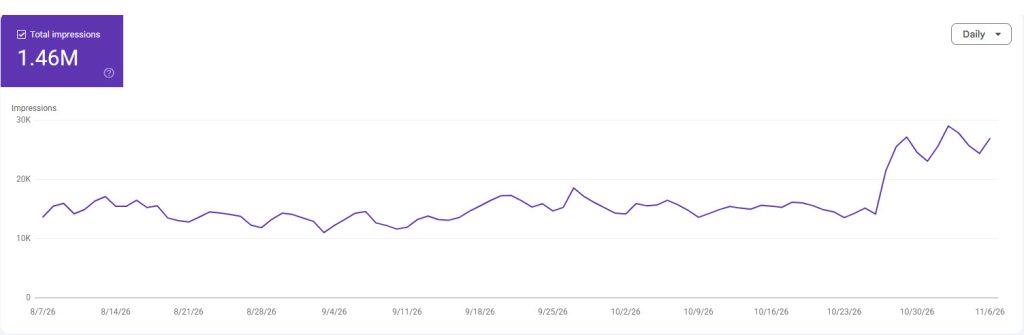
Overall AI impressions don’t necessarily tell you much about actual customer interest. The larger numbers often obscure what’s most important. For example, a seasonal article may generate thousands of impressions nationwide, while a location or specialty department receives far fewer but potentially more relevant appearances.
That’s why I began separating the reporting into store pages, departments, recipes, and informational content.
From September to October 2026, the retailer’s U.S. AI-feature impressions increased about 28%, reaching roughly 295,000. Much of that came from seasonal gardening content.
The store and department numbers were more interesting.
In September, combined AI impressions for store location pages increased about 27% over August. Location-page sessions also increased about 13%.
October was mixed. Overall AI impressions continued increasing, but store-page AI impressions dropped about 8%, while specialty department impressions increased approximately 15%.
For a regional company, I try to narrow traffic reporting to the actual service area as much as I can. This is more difficult with AI traffic. As of this writing, I can only narrow the audience to U.S. traffic in Google Search Console, which isn’t ideal for a business serving a limited geographic area.
Does AI Visibility Lead to More Customers?
Even if a business is cited or recommended in an AI response, it may not lead to a direct website click. If it’s a location-based business, the customer may simply visit the store.
This is similar to what we find with Google Maps searches. There may be no site traffic, but the search can still influence a store visit.
Fortunately, the client tracks overall store visits, and they’ve been ticking up slightly over this period. They’ve been doing other advertising, of course, so I wouldn’t attribute that increase directly to SEO or AEO work.
It’s one of the reasons I look at AI impressions as an indicator of visibility rather than a measure of business results.
Ongoing Work
The engagement is part of an ongoing process of content improvement, entity clarification, and SEO/AI search performance analysis.
The most interesting find is how much adding specific product and service information can influence both traditional search visibility and AI recommendations. The butcher shop was a good example, and I’ve seen similar results with other departments and pages.
AI search measurement is still limited, especially for local businesses. For now, I’m focusing on improving how these businesses are represented and tracking the trends that are measurable.
Is Your Business Discoverable in AI Platforms?